
July 10
In 1900 an immigration officer refused to admit any Chinese to the US and in 1971 Zhou Enlai equates economic expansion with war
On July 10th in US-China relations, an immigration and customs officer refused to admit Chinese travelers to the United States and Zhou Enlai continued a secret meeting with Henry Kissinger where he claimed concern about the US teaming up with the USSR to invade China and expressed curious ideas about the outcome of economic growth:
1901
“Collector Jackson today refused to admit any Chinese to United States because of outrages on Americans in China. Says he acts on his own responsibility. Order lasts during his pleasure which is indefinite. Please have him instructed to admit those entitled to enter, as usual.”
On this day in 1900, Secretary of State John Hay, previously referred to on July 3rd and June 25th, quoted the above lines from a telegram written by the Chinese Consul in San Francisco. In a letter to the Secretary of Treasury, (at that time, Treasury had authority over immigration and customs officials at US ports of entry), Hay asked the Treasurer to address the behavior of a recalcitrant customs official.
The greater context for why the official was angry about mistreatment of Americans concerns what is commonly referred to as the Boxer Rebellion, an historical event far more complex than can be described fairly here, though it is referred to briefly on June 22, and was ongoing at the time this letter was written.
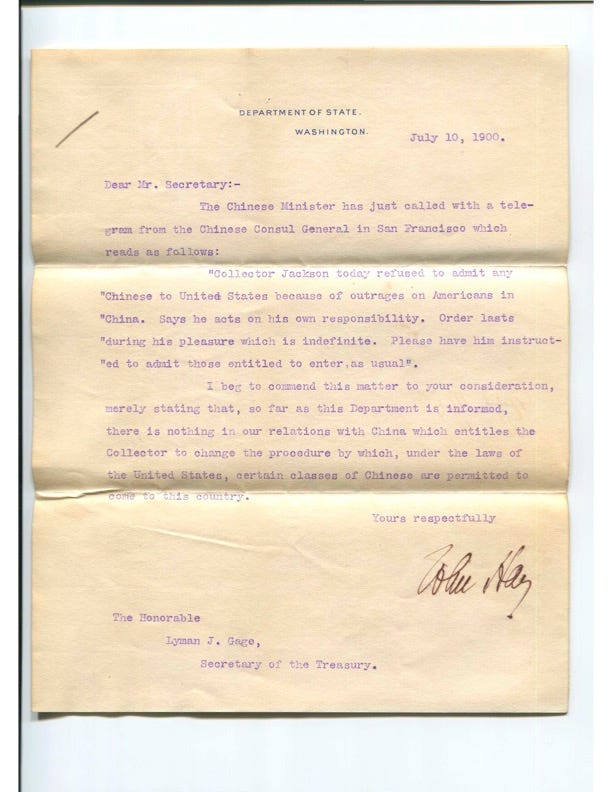
Source of John Hay’s letter at the National Archives
“They burned churches, destroyed telegraph lines and railways, and killed many Chinese Christians and foreign missionaries. On June 20, when the Manchu regime declared war on foreign powers, they laid siege to the foreign legations and a Catholic cathedral in Peking….The half-hearted siege ended on August 14, when the allied forces of eight nations…reached Peking. In 1901, the Boxer protocol exacted an indemnity which amounted to some $333,900,000. So great a disaster to the Manchu fortunes could have been precipitated only by leaders profoundly ignorant of the West, even granting the fact (which we have not emphasized) of great foreign provocation….The Boxers were thought of as loyal supporters of the dynasty, available for use in a showdown against the foreigners. All their irrational acts of violence - the killing of Christian converts and foreigners and the destruction of anything with a foreign connection - were regarded at the time as patriotic acts against foreign invaders. The mad superstition in and near Peking in the summer of 1900 was thus a product of ignorance, superstition, and mob hysteria.”
China’s Response to The West, A Documentary Survey 1839-1923, p.187
1973
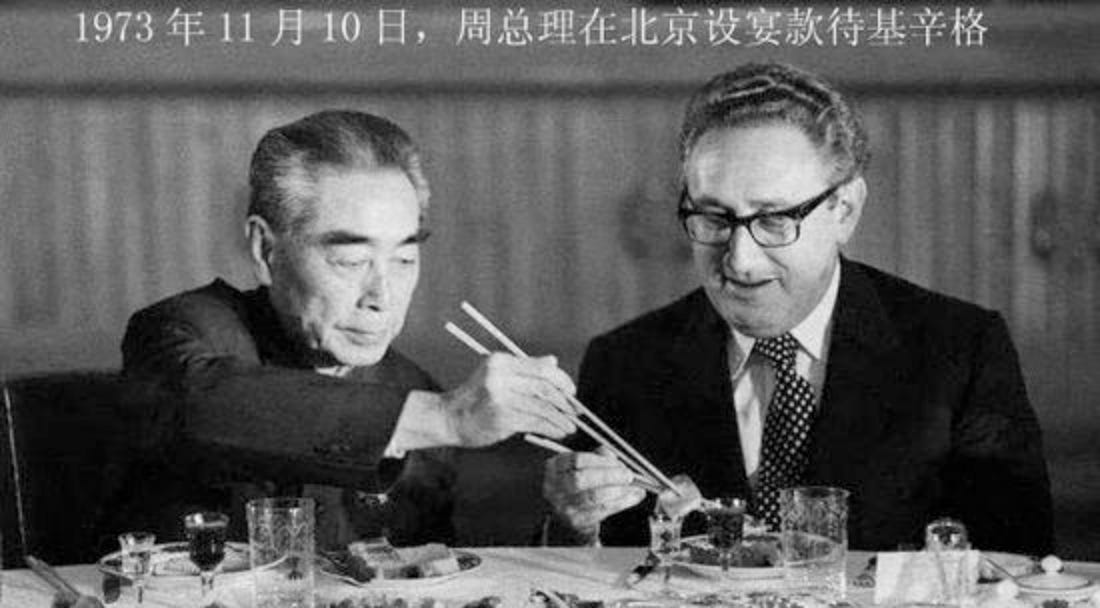
Zhou and Kissinger sharing a meal two and a half years later, in 1973
The State Department relates concerning the July 10th continuation of Kissinger and Zhou’s secret meeting:
“During his meeting with Kissinger the following afternoon, July 10, Zhou addressed several contingencies for China’s national security, [Page 828] in particular, those posed by the Soviet Union….In order to avoid any misunderstandings, Kissinger not only offered to brief Zhou on “any proposal made by any other large country which could affect your interests” but also promised to ‘take your views very seriously.’”
“The worst would be that China would be carved up once again,” he explained. “You could unite, with the USSR occupying all areas north of the Yellow River, and you occupying all the areas south of the Yangtze River, and the eastern section between these two rivers could be left to Japan.” After describing this point in more detail, Zhou returned to his central theme:
Zhou then expanded on his and Nixon’s thoughts on the state of the world and what the future may bring. Zhou cited Nixon’s prescient belief that the next few decades would bring about economic competition and expansion and Zhou sees this as necessarily requiring military expansion, implying this is the case with Japan, though whether he meant the past or the future is unclear. One wonders what Zhou would say about his own countries economic competition and expansion in the decades that followed:
“We believe that at present there is chaos under heaven, and believe that in the past 25 years there has been a process of great upheaval, great division, and great reorganization. Your President also said (in Kansas City) that 25 years ago you could not imagine that the present situation could emerge. He also said that in the remaining third of the century that efforts should be made to cease military competition and to embark upon economic competition. However, economic competition in itself involves economic expansion, and then will necessarily lead to military expansion. Japan is the most telling case in point, but the danger may not be less in the case of West Germany in relation to Europe.”1
https://history.state.gov/historicaldocuments/frus1969-76v17/d140